Fewer devil rays in the sea: Evidence of declining mobulid populations off India's coast
August 2026
Mayuri Chopra, Gwilym Rowlands, Guy M. W. Stevens, Daniel Fernando, Mohanraj T., Betty J. L. Laglbauer, Divya Karnad & Katrina J. Davis
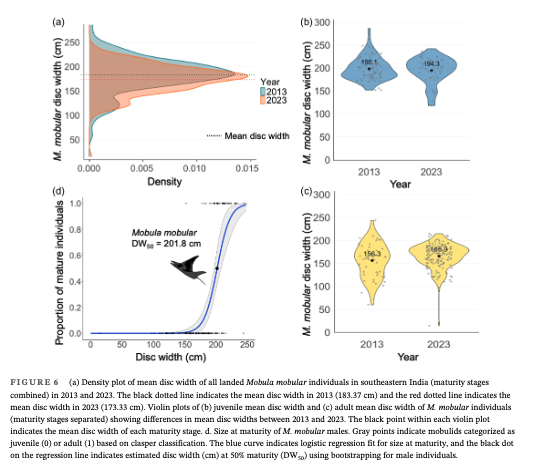
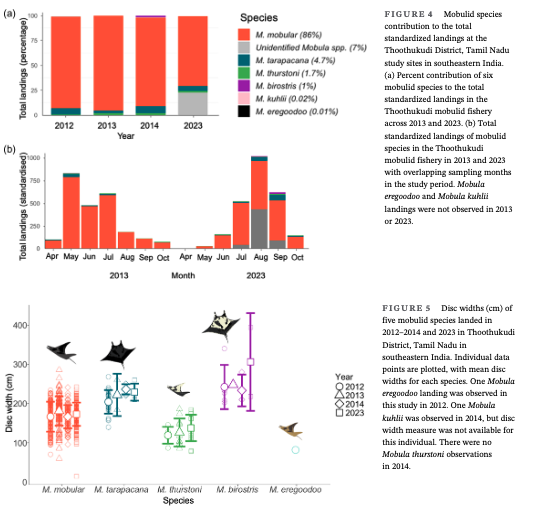
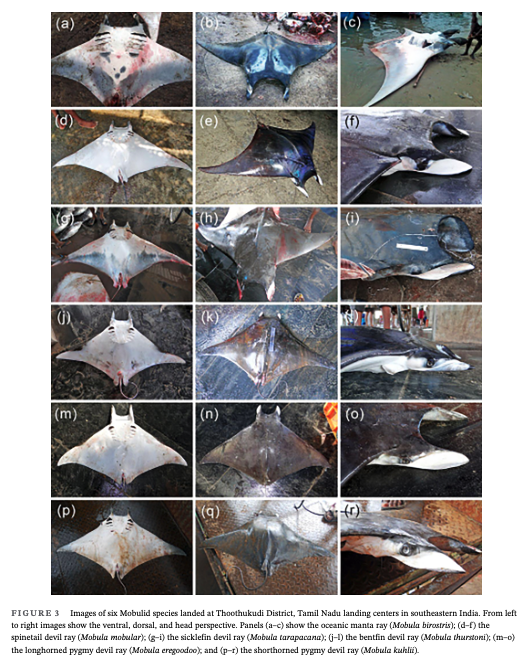
Summary: Limited and inaccurate catch data have hindered species-specific fishery assessments, particularly in data-limited fisheries where unregulated bycatch and low monitoring make population trends difficult to assess. In this study, researchers found significant declines in spinetail devil ray (Mobula mobular), sicklefin devil ray (M. tarapacana), oceanic manta ray (M. birostris), and bentfin devil ray (M. thurstoni) populations in India between 2013 and 2023. They also documented age-class truncation in spinetail devil rays, indicating a loss of older individuals. These declines coincided with increasing fishing pressure, suggesting overfishing is the primary driver. This is the first study to use multi-year data to empirically assess changes in India's manta and devil ray populations, strengthening the case for including all mobulid species in the country's no-take national legislation.
Abstract
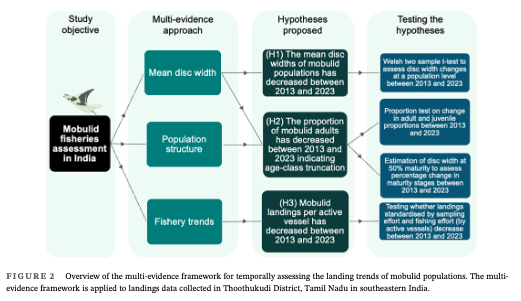
“Manta and devil rays (collectively, mobulids) are circumglobal, planktivorous pelagic rays. Mobulids are declining globally due to targeted and non-targeted capture. However, limited and inaccurate data have hindered species-specific fishery trend assessments, especially in data-limited fisheries where unregulated bycatch and low monitoring make assessments challenging. Assessing mobulid fishery trends is becoming critical due to intensifying fishing pressure, to understand population declines and guide protective measures. We used a combination of morphometric, demographic, and fishery metrics to assess how the population status of mobulids has changed temporally in India, the largest fishing nation for these species globally. Our results suggest a decline in Mobula mobular, Mobula tarapacana, Mobula birostris, and Mobula thurstoni populations between 2013 and 2023, and age-class truncation in M. mobular populations since 2013. These population declines have occurred alongside increasing fishing pressure, suggesting overfishing is responsible. This study is the first to use multiannual data to empirically assess changes in mobulid populations in India, reinforcing the need to include all mobulid species in India's no-take national legislation. Our research approach can be applied to other data-limited systems, demonstrating that alternative data can effectively assess population status even when reliable total catch data are unavailable, a common challenge worldwide.”
Infographic
Infographic by Leila Scheltema
Author Affiliations
University of Oxford
The Manta Trust
University of Southampton
Blue Resources Trust
Manonmaniam Sundaranar University
University of Exeter
Contribution towards the Manta Trust's Strategic Plan
Goal 1: Strategic Objective 1.1 – More protective policies exist to support manta and devil ray conservation for geographical focus areas.
Goal 1: Strategic Objective 1.2 – There is improved enforcement of existing protective policies.
Goal 2: Strategic Objective 2.1 – Fishers within focus areas are working towards measures to reduce capture and bycatch mortality.
Goal 2: Strategic Objective 2.2 – Regulations and effective enforcement exist to reduce manta and devil ray capture and bycatch mortality.
Goal 3: Strategic Objective 3.1 – All manta and devil ray species in the regions where we work are fully protected and conserved through species management plans.