
Critical habitats for sharks and rays in Asia remain largely unprotected
May 2026
Adriana Gonzalez-Pestana, Peter M. Kyne, Emiliano García-Rodríguez, Ryan Charles, Vanessa Bettcher Brito, Asia O. Armstrong, Amanda Batlle-Morera, Marta D. Palacios, Christoph A. Rohner, Giuseppe Notarbartolo di Sciara, Jo Marie V. Acebes, Serena Adam, Ariana S. Agustines, Faqih Akbar Alghozali, Chethana L. Amadoru, Rohani Ambo-Rappe, Maria Theresa R. Aquino, Gonzalo Araujo, Janis Argeswara, Bella Riskyta Arinda, Sirachai Arunrugstichai, Elisabeth Astari, Lisa-Marie Auditore, Avik Banerjee, Clare M. Baranowski, Alissa J. Barnes, Calvin S. Beale, Sweta Beura, Jessica-Anne Blakeway, Titus E. Cañete, Nantarika Chansue, Andrew Chin, Supachok Chittapisan, Metavee Chuangcharoendee, Fung Chen Chung, Thilini Dilrukshi, Mareike Dornhege-Lazaroff, Christine L. Dudgeon, Mark V. Erdmann, Fahmi, Elisabeth Fahrni Mansur, Daniel Fernando, Keisuke Furumitsu, Anna L. Flam, Syamsidar Gaffar, Peter Gausmann, Ramajeyam Gobiraj, Michael I. Grant, Alifa B. Haque, Kojiro Hara, Simon T. Hilbourne, Kooi Chee Ho, Hua Hsun Hsu, Neil Hutchinson, Nesha K. Ichida, David M. P. Jacoby, Eswar S. Jarugulla, Divya Karnad, Bineesh Kinattumkara, Shoba Joe Kizhakudan, Alp Gokgoz, Muhammad Wiralaga Dwi Gustianto, Thanda Ko Gyi, Lavina, Chia-Yun J. Li, Eurida Liyana, Aaron Savio Lobo, Kirsty Magson, Petch Manopawitr, Catherine D. McCann, David A. McCann, Muktha Menon, Meira Mizrahi, Anil Mohapatra, Maizah Mohd Abdullah, Richard N. Muallil, Ryan Murray, Efin Muttaqin, Evan M. Nazareth, Anusha Neranjan, Raisa Noor, Budi Nugraha, Simon P. Oliver, Sue Andrey Ong, Alexei M. Orlov, Sharang Payyat, Nicolas J. Pilcher, Alessandro Ponzo, Prehadi, Mochamad Iqbal Herwata Putra, Van Quang Vo, Joshua Rambahiniarison, L. Remya, Akbar Reza, Subal Kumar Roul, Swatipriyanka Sen, Citra Septiani, Abraham B. Sianipar, Pascal Sebastian, Edy Setyawan, Mohammad Shamsuddoha, Rafid A. Shidqi, Benaya M. Simeon, Sitha Som, Serena J. Stean, Davies Austin Spiji, Dipani Sutaria, Akshay Tanna, Amy Y. H. Then, Sujitha Thomas, Nicholas J. Tolen, Micaela L. Trebol, Zoya Tyabji, Jean Asuncion T. Utzurrum, Stephanie K. Venables, Igor V. Volvenko, Christine A. Ward-Paige, Atsuko Yamaguchi, Arnel Yaptinchay, Ranny R. Yuneni, Jie Zhang, Fabienne Ziadi-Künzli, Masiat A. Zubair & Rima W. Jabado
Keywords: Citizen Science • Chondrichthyans • Conservation • Diversity Hotspots • Marine Protected Areas • Spatial Planning
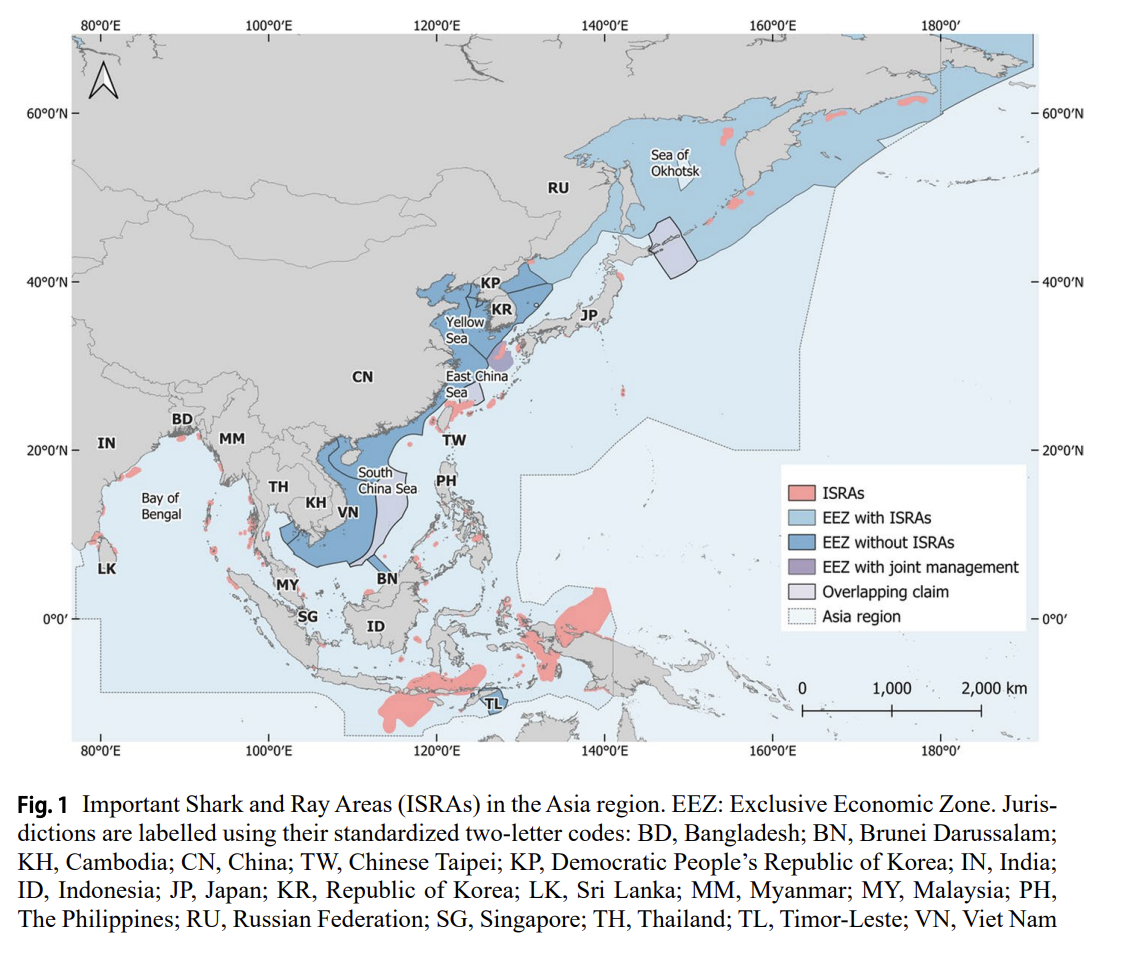
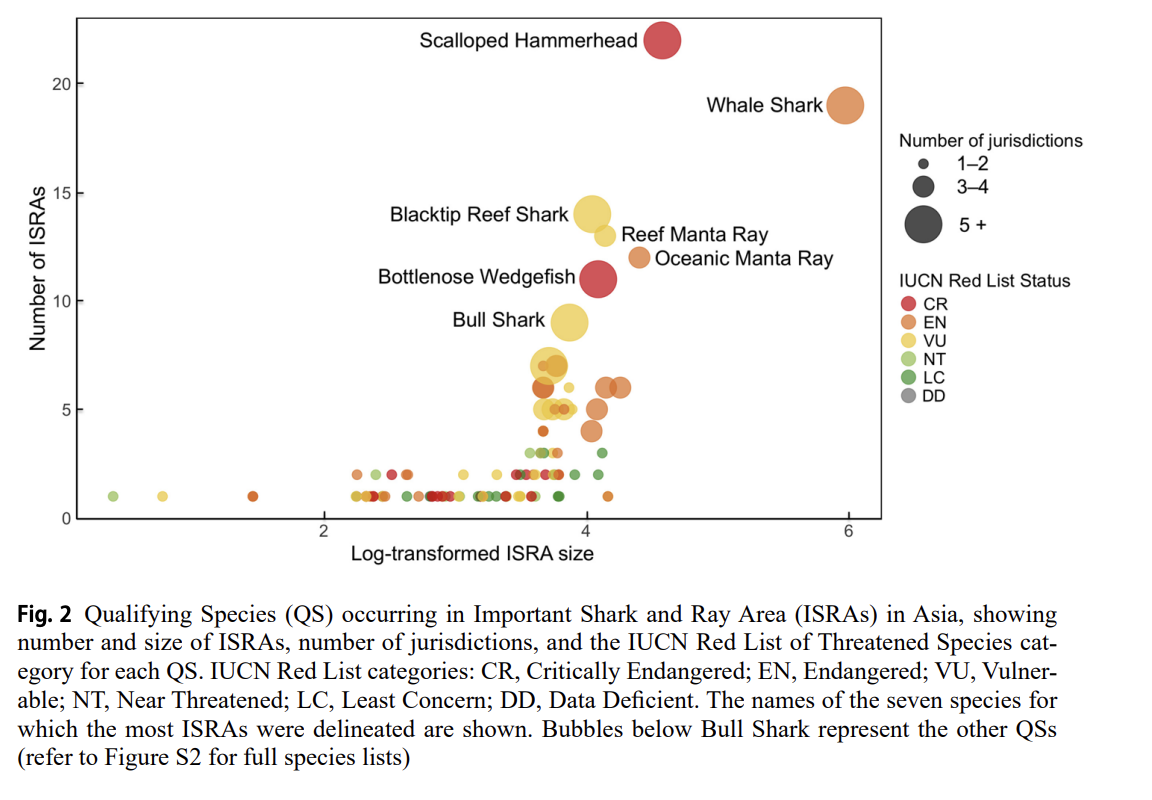
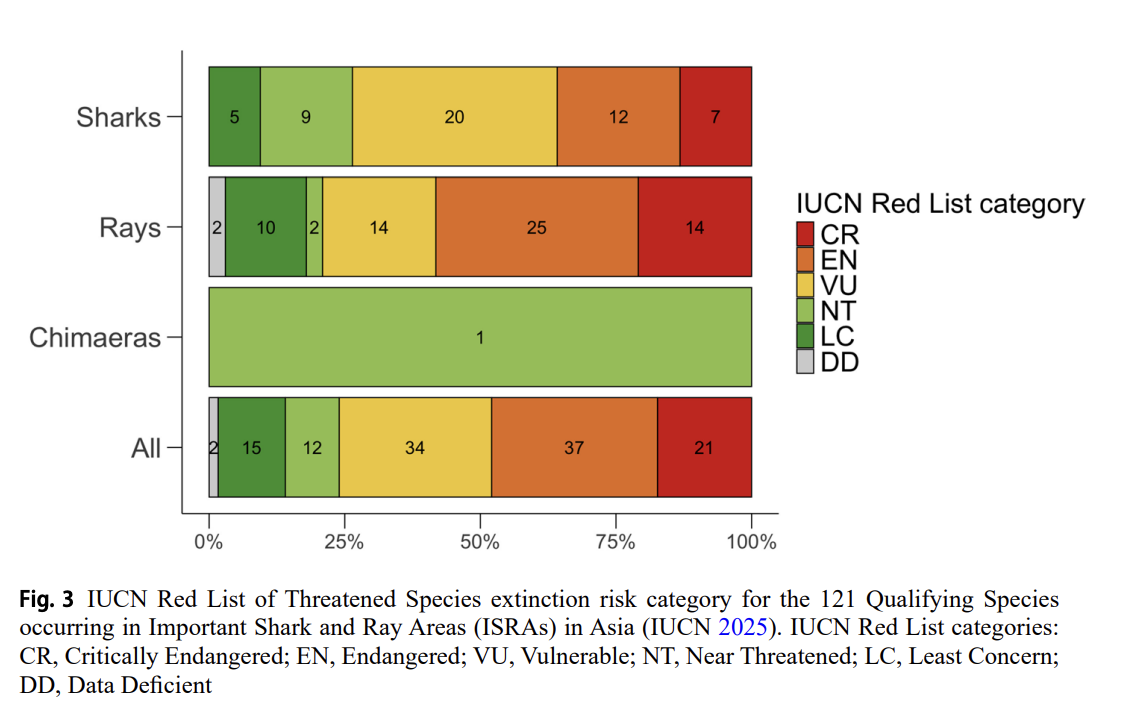
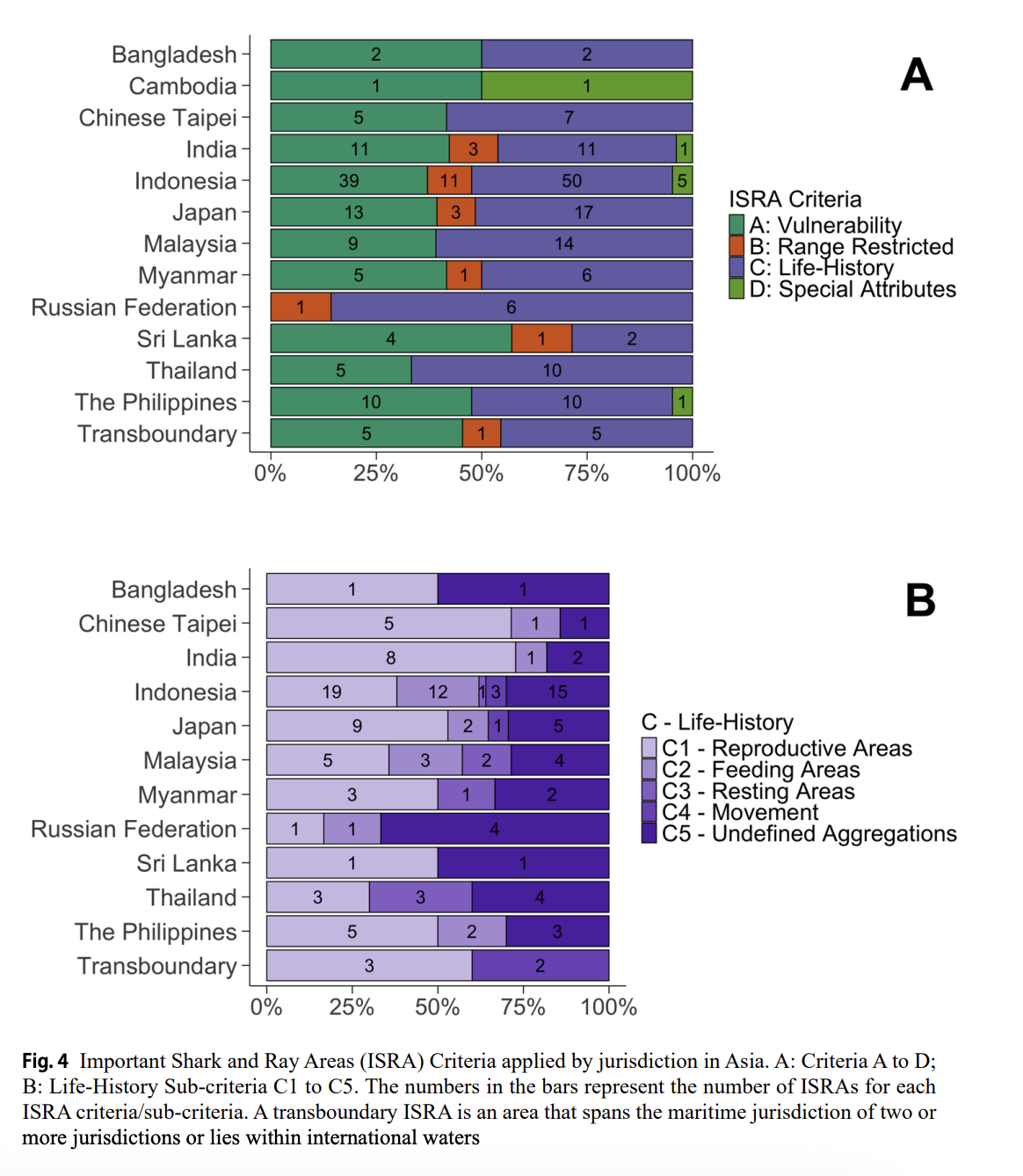
Summary: Asia supports exceptional shark, ray and chimaera diversity but faces severe fishing pressure. Using the Important Shark and Ray Area (ISRA) framework, researchers identified 122 critical habitats covering around 1 million km² (3% of the region) across 12 jurisdictions and international waters. These areas support 121 species, 76% of which are threatened. Nearshore reproductive habitats were most commonly recognised, while deepwater and freshwater species were underrepresented. Geographic and data coverage were uneven, with several countries lacking ISRAs. Protection remains limited: only 5.4% of ISRA area falls within marine protected areas and 2.8% overlaps with no-take zones. Findings highlight priorities for conservation and spatial planning.
Abstract
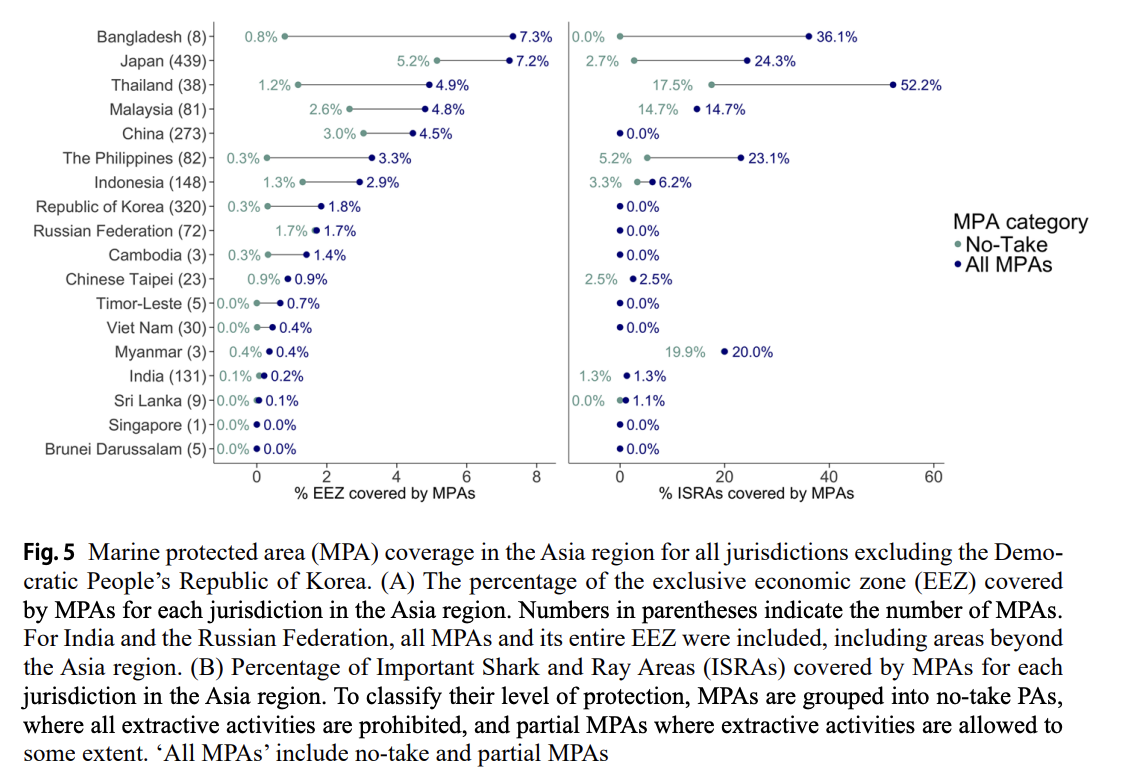
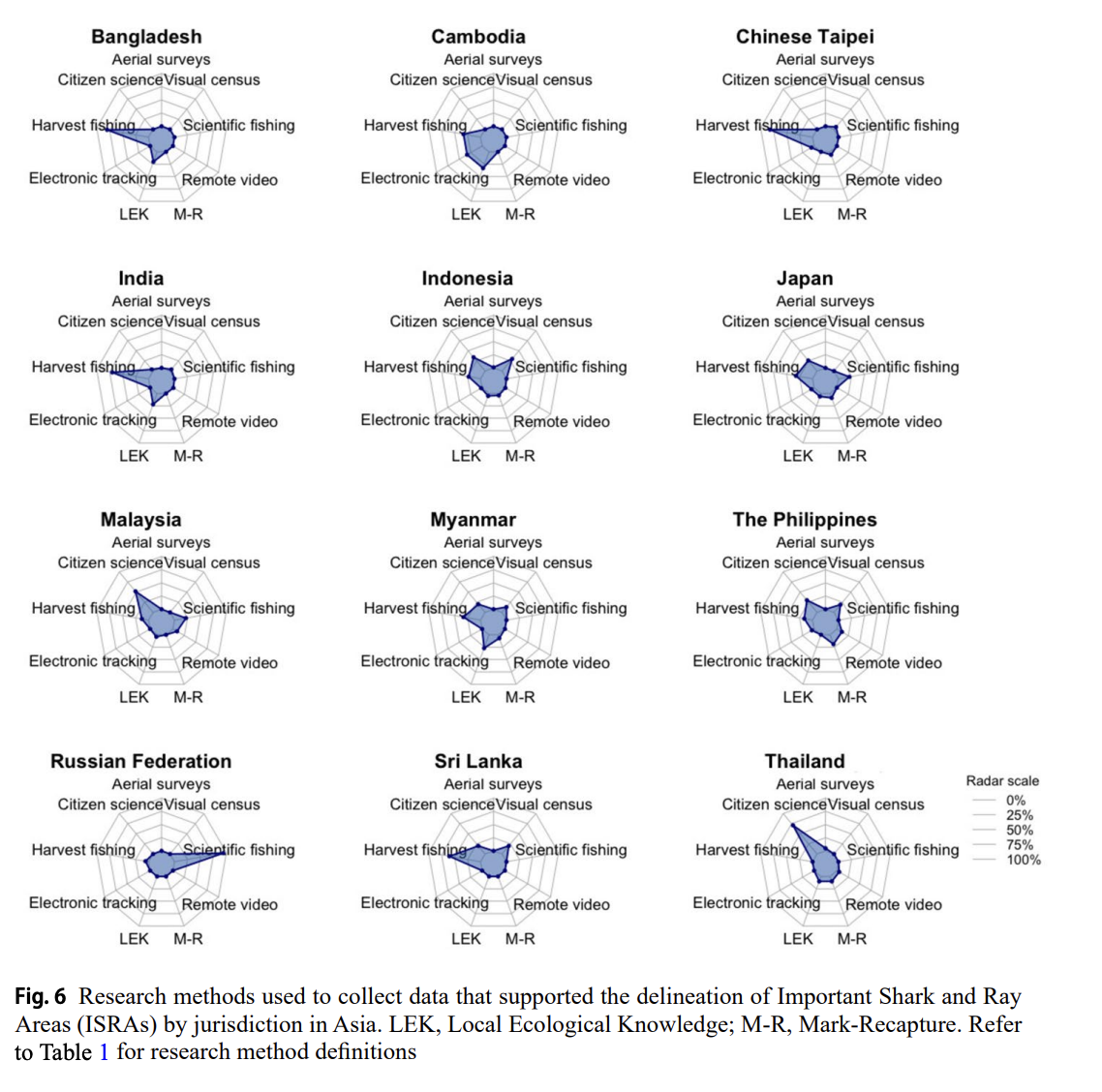
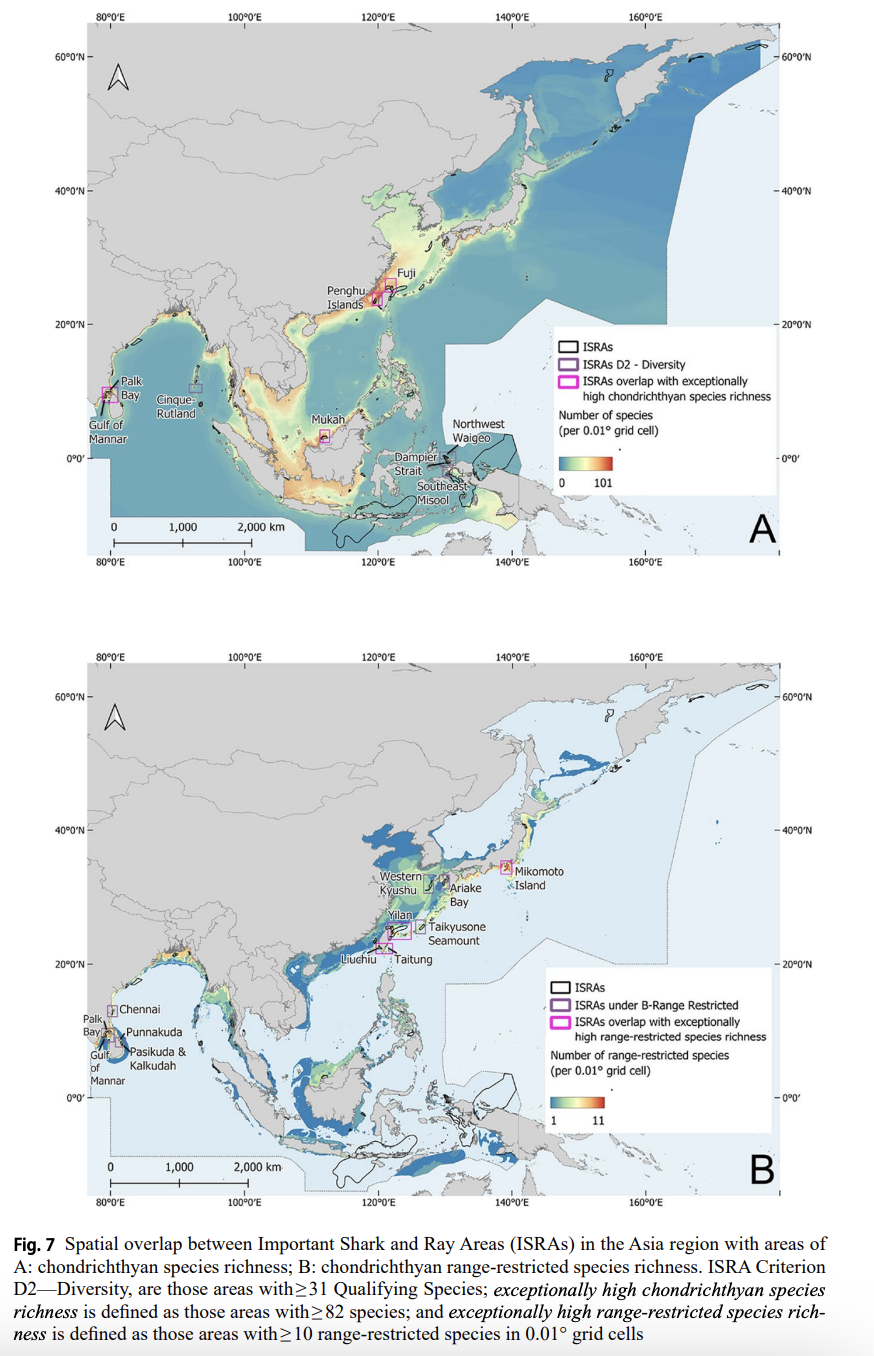
“The Asia region harbors exceptional chondrichthyan (shark, ray, and chimaera) diversity but faces intense fishing pressure. The Important Shark and Ray Area (ISRA) process provides a collaborative, evidence-based framework to identify critical habitats and inform spatial management. We assessed ISRAs across the Bay of Bengal, Southeast Asia, and the Northwest Pacific to characterize their extent, ecological significance, and conservation relevance. We delineated 122 ISRAs spanning ~ 1 million km2 (~ 3% of the region) across 12 jurisdictions and international waters, encompassing habitats for 121 species (~ 30% of Asia’s chondrichthyans), 76% of which are threatened. Depleted taxa (e.g., giant guitarfishes, Glaucostegidae) were represented, but charismatic megafauna (e.g., Whale Shark Rhincodon typus) were overrepresented. In contrast, deepwater and freshwater species were underrepresented. Reproductive Areas were the most common ISRA sub-criterion applied (52% of ISRAs), largely in nearshore zones, while areas for range-restricted species were less frequently (18%) identified. Twelve ISRAs overlapped with biodiversity hotspots, including seven in areas of high overall chondrichthyan species richness and five in areas of high range-restricted species richness. Citizen science was the predominant research method used to delineate ISRAs, while fisheries data were underused despite the region’s major fisheries footprint. Geographic coverage was uneven: Indonesia held the most ISRAs (n = 40; 71.7% of ISRA coverage) while eight jurisdictions (e.g., Viet Nam, China, Republic of Korea) lacked ISRAs due to data gaps. Protection shortfalls are stark: MPAs cover < 5% of national waters in 16 jurisdictions (eight with < 1%); 5.4% of ISRA area lies within MPAs; and only 2.8% of ISRA spatial extent overlaps with no-take zones. These results provide a regional foundation to guide spatial planning, prioritize management, close data gaps, and support recovery of Asia’s diverse and imperiled chondrichthyan assemblages.”
Author Affiliations
IUCN Species Survival Commission Shark Specialist Group
Research Institute for the Environment and Livelihoods, Charles Darwin University
University of the Sunshine Coast
Marine Megafauna Foundation
IUCN Marine Mammal Protected Areas Task Force
BALYENA.ORG
World Wide Fund for Nature (WWF)
Large Marine Vertebrates Research Institute Philippines
Elasmobranch Project Indonesia
Blue Resources Trust
Hasanuddin University
Marine Wildlife Watch of the Philippines
Marine Research and Conservation Foundation
Qatar University
Yayasan Megafauna Laut
YAPEKA
Thai Sharks and Rays
Penabulu Foundation
Wildlife Conservation Society India
The Manta Trust
Murdoch University
Raja Ampat Manta Project
Zoological Survey of India
Earth Agenda Foundation
Chulalongkorn University
James Cook University
WildAid
Universiti Malaysia Sabah
Okinawa Coastal Protection Alliance
Biopixel Oceans Foundation
ReShark
Re:wild
Research Center for Oceanography
Marine Conservation Practitioner
Nagasaki University
Borneo Tarakan University
Ruhr University Bochum
Deutsche Elasmobranchier Gesellschaft
University of Dhaka
Bengal Elasmo Lab
S-Pool Blue Dot Green
Marine Research Foundation
Fisheries Research Institute
James Cook University Singapore
Universiti Malaysia Terengganu
Thrive Conservation
Lancaster University
Ashoka University
University of Exeter
ICAR–Central Marine Fisheries Research Institute
University of Chester
Thresher Shark Research and Conservation Project
Myanmar Ocean Project
Georgia Aquarium
Ghent University
New Heaven Reef Conservation Program
Thai Whale Sharks
Department of Marine & Coastal Resources
The Sea Collective
Wildlife Conservation Society – Southeast Asia Pacific
Zoological Survey of India Odisha
Mindanao State University – Tawi-Tawi College of Technology and Oceanography
Met Éireann
Rekam Nusantara Foundation
Nature Conservation Foundation
Wildlife Conservation Society Bangladesh
Research Center for Fishery
Wildlife Conservation Society Philippines
Shirshov Institute of Oceanology
A.N. Severtsov Institute of Ecology and Evolution, Russian Academy of Sciences
Tomsk State University
Ministry of Marine Affairs and Fisheries
Konservasi Indonesia
Institute of Oceanography, VAST
Coastal Oceans Research and Development in the Indian Ocean (CORDIO)
Gadjah Mada University
World Resources Institute Indonesia
Elasmobranch Institute Indonesia
Indo Ocean Foundation
Jahangirnagar University
Duke University
Thresher Shark Indonesia
Wildlife Conservation Society Cambodia
Mississippi State University
Wildlife Conservation Society Malaysia
Dakshin Foundation
University of Malaya
Philippine Reef and Rainforest Conservation Foundation, Inc.
Dalhousie University
Silliman University
eOceans
Chinese Academy of Sciences
Okinawa Institute of Science and Technology
Elasmo Project
Funding
Shark Conservation Fund
CAUL
Contribution towards the Manta Trust's Strategic Plan
Goal 1: Strategic Objective 1.1 – More protective policies exist to support manta and devil ray conservation for geographical focus areas.
Goal 2: Strategic Objective 2.2 – Regulations and effective enforcement exist to reduce manta and devil ray capture and bycatch mortality.
Goal 3: Strategic Objective 3.2 – Key manta and devil ray aggregation sites fall within protected areas that are effectively managed.
Goal 3: Strategic Objective 3.5 – Spatial and temporal overlap between manta and devil ray habitat use and anthropogenic threats (e.g., fisheries, shipping, entanglement) is identified to inform mitigation and conservation measures.