A new visual index for assessing zooplankton biomass and its utility in assessing prey availability for megaplanktivores
May 2026
Hannah M Moloney, Asia O Armstrong, Guy M W Stevens, Christine L Dudgeon, Joanna L Harris, Kathy A Townsend & Anthony J Richardson
Keywords: Plankton • Blooms • Marine • Planktivores • Prey Abundance
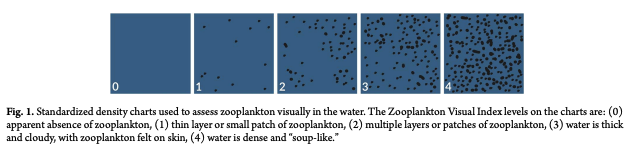
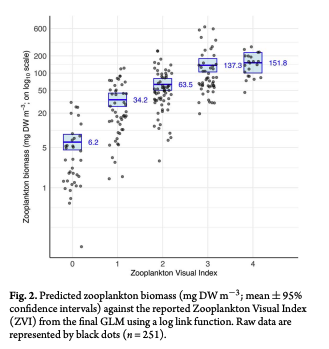
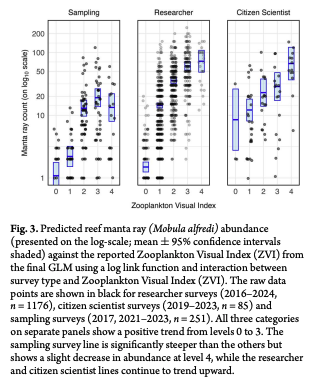
Summary: Zooplankton biomass is difficult to measure across large marine environments. This study presents the Zooplankton Visual Index, a rapid semi-quantitative method using underwater observations to estimate biomass. Validation with net samples showed consistent relationships between index levels, biomass, and community composition. Applied to nine years of reef manta ray observations in the Maldives, higher manta abundance correlated with elevated index levels. The index provides an accessible tool for monitoring prey availability and supporting research and conservation efforts for marine megaplanktivores.
Abstract
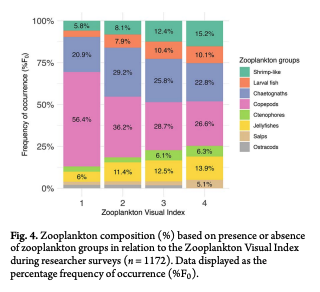
“Zooplankton are vital links in marine food webs, yet their biomass remains challenging to quantify across broad spatial and temporal scales. This study introduces the Zooplankton Visual Index–a simple, rapid and scalable semi-quantitative method for evaluating zooplankton biomass through underwater observations. Following the establishment of a standardized protocol, validation against in situ net samples demonstrated that index levels increased consistently with measured biomass and predictable shifts in community composition. We then applied the validated index to a 9-year dataset of reef manta ray (Mobula alfredi) sightings in the Maldives. Increased M. alfredi abundance significantly correlated with higher index levels, confirming that the index effectively captures the food environment as an important predictor of behavior and habitat use. Thus, the Zooplankton Visual Index provides an accessible and validated tool for assessing prey availability, enabling researchers, non-specialist field staff and citizen science programs to contribute to broad-scale ecological research and conservation efforts for marine megaplanktivores.”
Author Affiliations
University of the Sunshine Coast
The Manta Trust
Maldives Manta Conservation Programme
Commonwealth Scientific and Industrial Research Organisation (CSIRO)
IUCN SSC Shark Specialist Group
Biopixel Oceans Foundation
University of Plymouth
The University of Queensland
Funding
University of the Sunshine Coast
Save Our Seas Foundation
Carl F. Bucherer
Four Seasons Resort at Landaa Giraavaru, Maldives
Contribution towards the Manta Trust's Strategic Plan
Goal 1: Strategic Objective 1.1 – Scientific research and monitoring priorities are identified and addressed to improve understanding of manta and devil ray populations, ecology, habitat use, threats, and conservation needs.
Goal 1: Strategic Objective 1.3 – Knowledge of manta and devil ray critical habitats, aggregation sites, and environmental drivers is improved to support conservation management.
Goal 4: Strategic Objective 4.1 – More people (a diverse range of individuals) local to manta and devil ray conservation initiatives play an active role in their design and implementation.