
Valuing conservation and natural wealth: The blue economy of manta ray watching in the Maldives
June 2026
Hannah M. Moloney, Maria I. Garcia Rojas, Nina Rothe, Asia O. Armstrong, Kirsty Ballard, Florence Barraud, Farah Hamdan, Anthony J. Richardson, Enas Mohamed Riyad, Tamaryn J. Sawers, Kathy A. Townsend & Guy M. W. Stevens
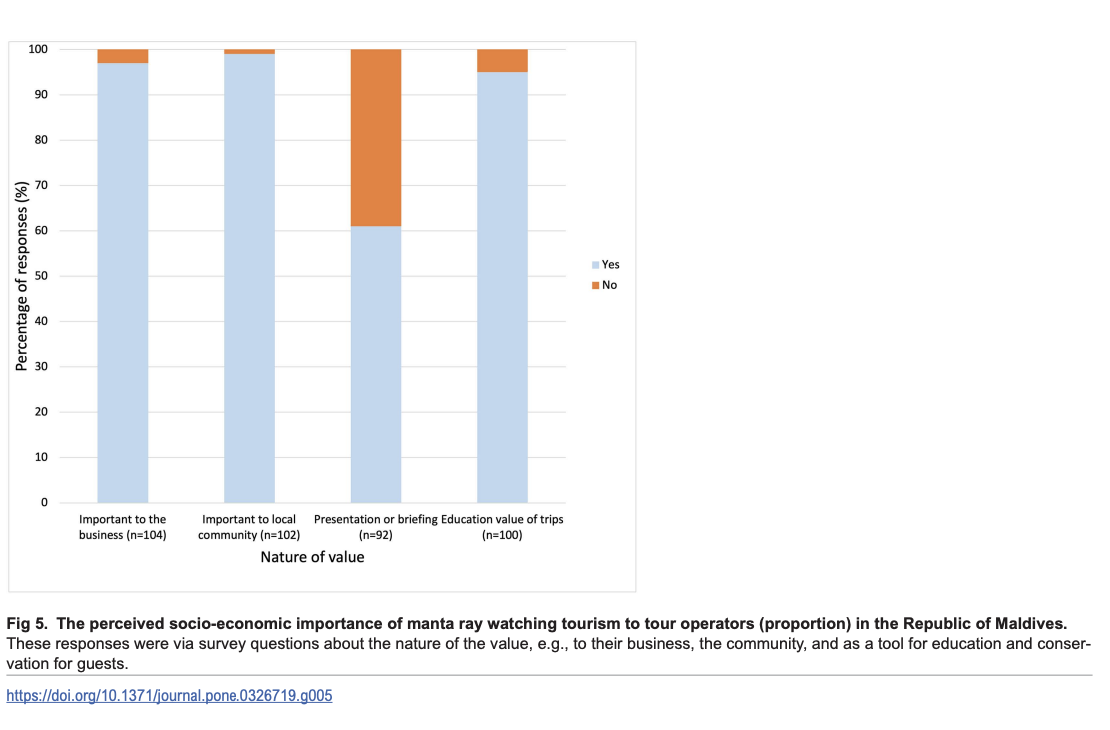
Summary: Global manta ray populations are declining, yet manta ray tourism delivers major economic and conservation benefits. In the Maldives, where healthy marine ecosystems support livelihoods and national prosperity, this study used tour operator surveys and data analysis to assess the industry's value. In 2021, manta ray tourism generated an estimated US$227.3 million, including excursion revenues and related tourist spending, equivalent to 2.6% of national GDP. The industry has expanded by around 380% since 2008 and is now offered by 80% of tourism operators. Manta rays also hold cultural significance, with total economic benefits exceeding US$311 million annually, supporting conservation-focused management and sustainable development.
Abstract
“Amid declining manta ray populations globally, the well-established and growing manta ray tourism industries generate substantial economic benefits and aid protective legislation for these threatened elasmobranchs. As flagship species, manta rays are a drawcard for marine wildlife tourism and a gateway for engaging the public and communities in conservation. Healthy marine ecosystems are the key drivers of employment and economic sustainability for island nations such as the Maldives. However, there are many stakeholders competing for these shared resources, which can result in environmental degradation. Economic valuations are a powerful tool for justifying the conservation efforts of threatened species and natural areas, especially in light of competing stakeholders. Using tour operator surveys (n = 106) and data mining, this study provides an updated assessment of manta ray watching tourism in the Maldives and represents the first national valuation of its direct economic and socio-economic benefits. In 2021, manta ray tourism in the Maldives generated an estimated US$227.3 million, including US$39 million on manta ray focused diving and snorkelling excursions, and US$188.3 million in related tourist expenditure, representing 2.6% of the national Gross Domestic Product. This industry appears to have grown around 380% since 2008 (US$8.1 million) and manta ray watching is now offered by 80% of tourism operators nation-wide. Our findings revealed that manta rays hold intrinsic value and cultural significance within local communities. Acknowledging this, the flow-on benefits to the community extend beyond this industry, reaching local businesses, employed staff, and the government with the direct economic benefits of the manta ray tourism industry are estimated at over US$311 million per year. Such value highlights the significance of manta rays for the Maldives and the need for effective management centred on manta ray conservation to safeguard future prosperity and mitigate the potential impact of tourism on manta ray populations.”
Infographic
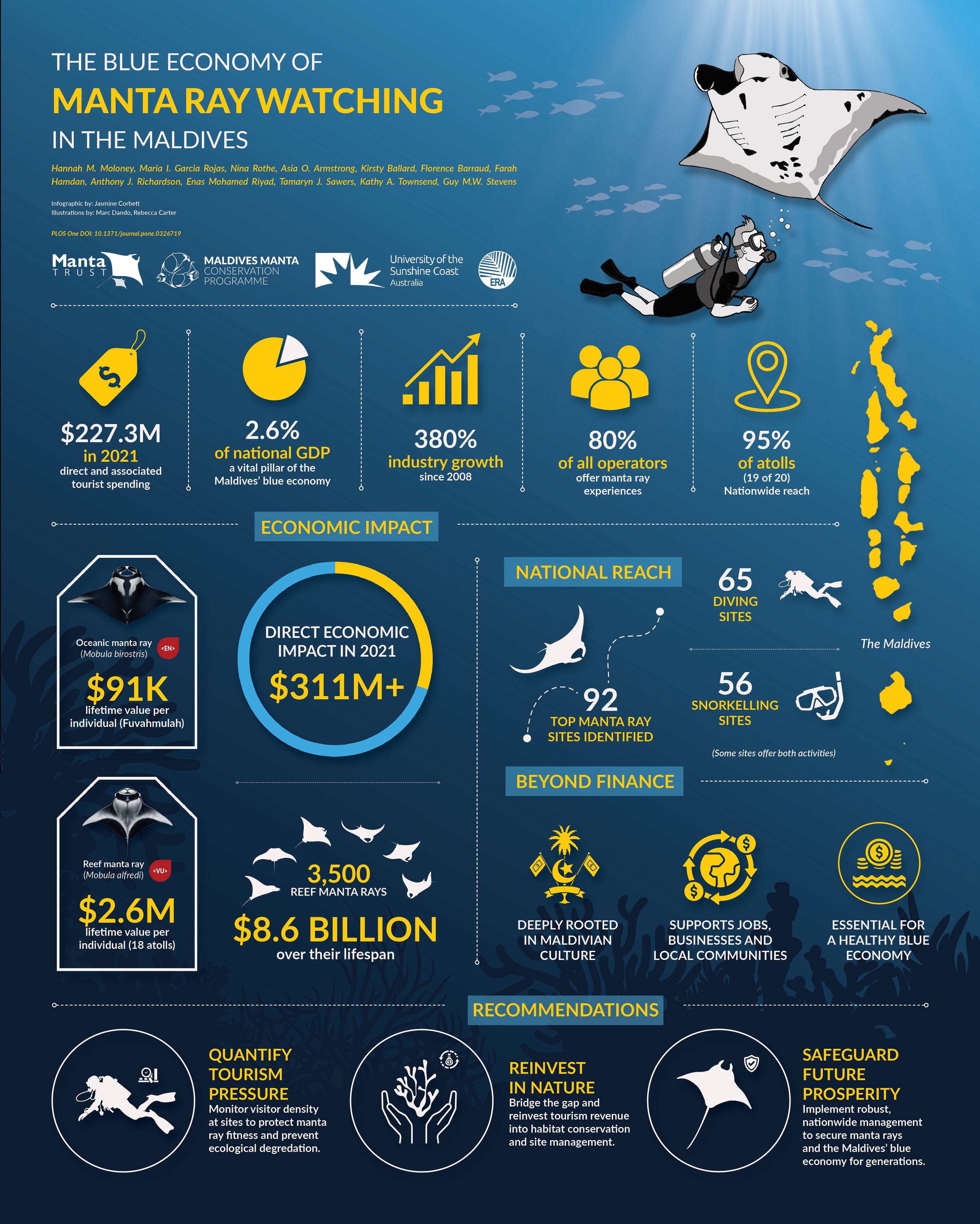
Infographic by Jasmine Corbett
Author Affiliations
The Manta Trust
University of the Sunshine Coast
Maldives Manta Conservation Programme
IUCN SSC Shark Specialist Group
University of the Sunshine Coast
Coastal Oregon Marine Experiment Station
Queen's University Belfast
The University of Queensland
Commonwealth Scientific and Industrial Research Organisation (CSIRO)
Environmental Regulatory Authority
Contribution towards the Manta Trust's Strategic Plan
Goal 3: Strategic Objective 3.2 – Key aggregation sites fall within protected areas that are effectively managed
Goal 3: Strategic Objective 3.3 – The majority of tourists and operators comply with responsible practices
Goal 4: Strategic Objective 4.2 – Tourists and operators are supportive of conservation and act accordingly
Goal 4: Strategic Objective 4.3 – A greater diversity of people seek careers in marine conservation